One tool I’ve come to love as a writer is writing dice. I’ve challenged myself to use them on many occasions, and they’ve definitely helped boost my creativity and flexibility.
My First Experience
My first introduction to the concept of writing dice happened in sixth grade. While my teacher didn’t use actual dice, we did pull words out of hats—two nouns, a verb, and an adjective. I wish I still had the story I wrote from that exercise! All I remember is that it was Christmas time, and two of my words were “elf” and “exploding.” I ended up writing a short story about a secret agent elf on a mission to deliver presents to kids around the world. I don’t remember what exploded, but I’m pretty sure my elf walked away from the blast wearing sunglasses (because that’s what cool elves do).
Explosions aside, this was my first time creating a story with only a few random words. Before that, I’d always used detailed story prompts or had a story idea in mind. Getting random words like “elf” and “exploding” forced me to think outside the box and connect them into something coherent. This kind of exercise is a great way to stretch your creativity—sometimes, you just need a bit of fun nonsense to shake up your day or get you through some writer’s block.
What Are Writing Dice?
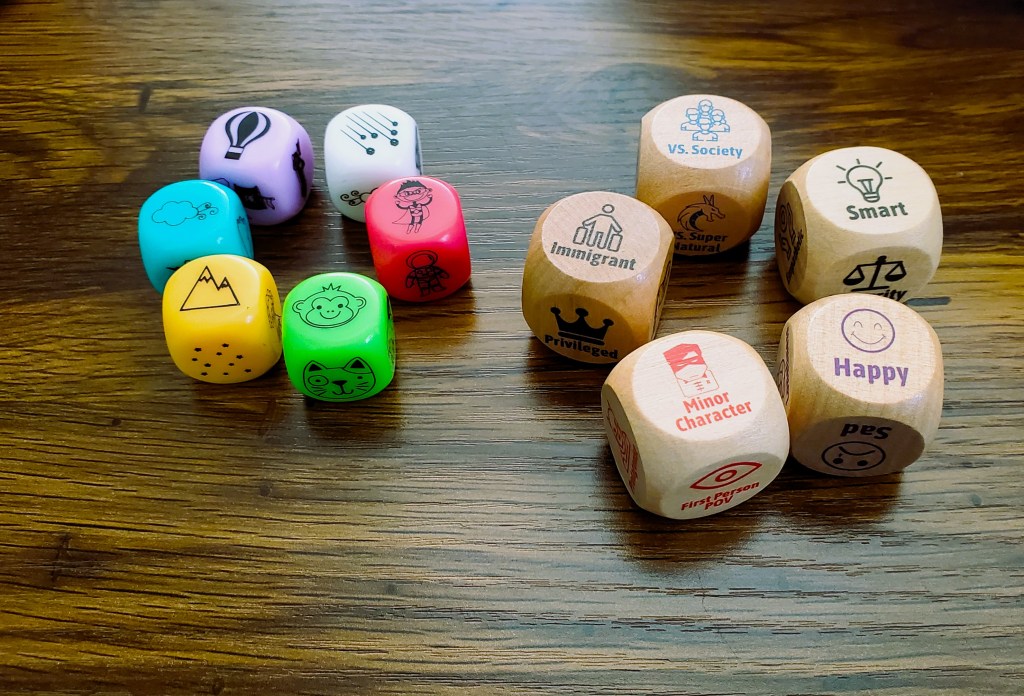
Writing dice are typically a set of dice, with each die having one word related to a part of speech. There are often 3-4 dice, with two dice having different nouns, one having verbs, and one with adjectives. If you don’t have actual dice, you can use a regular six-sided die and a dice table, where each number corresponds to a specific word in a specific category (see below). The basic idea is to roll one die for each part of speech (noun, adjective, verb) and create a story using the words you rolled.
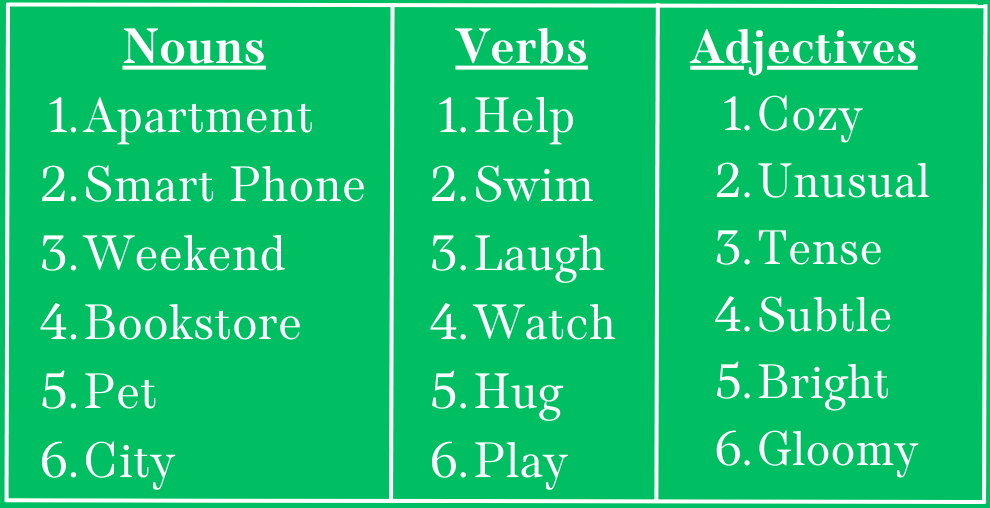
As I’ve become a more experienced writer, I’ve upped the challenge. Now, I try to put all three words into the same sentence and build the story from there. You can make the exercise easier or harder depending on how many dice (or tables) you use, but no matter the approach, it’s a fantastic creative boost.
Variations on Writing Dice
There are plenty of versions of story dice out there. Some include adverbs, emotions, or conflicts, giving the prompts even more depth. I also have a set of “story dice” that feature pictures instead of words, allowing even more flexibility. You can interpret the images however you want, adding extra layers of creativity. Check out my Writing Wednesday post for more on using story dice for writing prompts!
If you don’t have writing dice, you can still create your own tables and use a regular die to select words randomly. If you need ideas, I often post writing prompts on my social media (Facebook, Instagram, Pinterest) so you can follow along with your own six-sided die!
The Challenge
For one of my recent Writing Wednesday post, I created dice tables and rolled a set of standard dice so others could learn how to use writing dice. I created a prompt for each day of the week with three dice tables: nouns, verbs, and adjectives. From there, I challenged myself to create a sentence for each prompt and turned one into a short story, which I’ll share on Fiction Friday!
There are countless ways to challenge yourself with writing dice. Sometimes, I make it more difficult by rolling twice and combining two sentences into a single story. This forces me to think even more creatively and to connect ideas that may not naturally fit together. You can also add extra dice or use a longer list with a non-standard die, like a 20-sided die.
Getting Targeted with Dice
If I want to target a specific story I’m working on (generally to overcome difficulties when moving from scene to scene), I’ll create custom tables with words from that story. Then, I’ll roll dice like I’m playing a tabletop RPG (Dungeons & Dragons, anyone?), and then connect the two scenes with the randomly generated sentence and a LOT of creativity! I can then expand this with adjectives, plot points, or even quests—endless possibilities! It will likely be tossed with final edits, but it helps me gain a new perspective on my story and overcome my hurdle.
If you decide to do targeted dice rolling, I suggest keeping it to 2-4 tables and generating 2-4 words for your sentence. From there, write a 250-500 word scene that bridges the two seemingly unconnected scenes. It may not solve my plot problem instantly, but it will get you thinking creatively!
Benefits of Using Writing Dice
Using writing dice for inspiration and troubleshooting has made me a more flexible writer. When two scenes don’t seem to connect, I remember that time I wrote a story about elves and explosions and made a fun little story. Then, I realize I might be forcing the plot too hard in my book. Sometimes, I just need some spontaneous creativity! When I’m stuck, I pull out the dice, and they might lead me to something totally unexpected—a futuristic robot scene or a character’s vision about prophecies—either way, it’s usually the spark I need to move forward.
While writing dice may not be for everyone, they’ve been a great tool for me. They help me think outside the box and are a fun way to loosen up creatively. I don’t use them constantly (that could lead to chaos in my stories), but they’re a great addition to my writing toolbox whenever I need to get unstuck.
Happy dice rolling!
B.R. Quinn

 B.R. Quinn