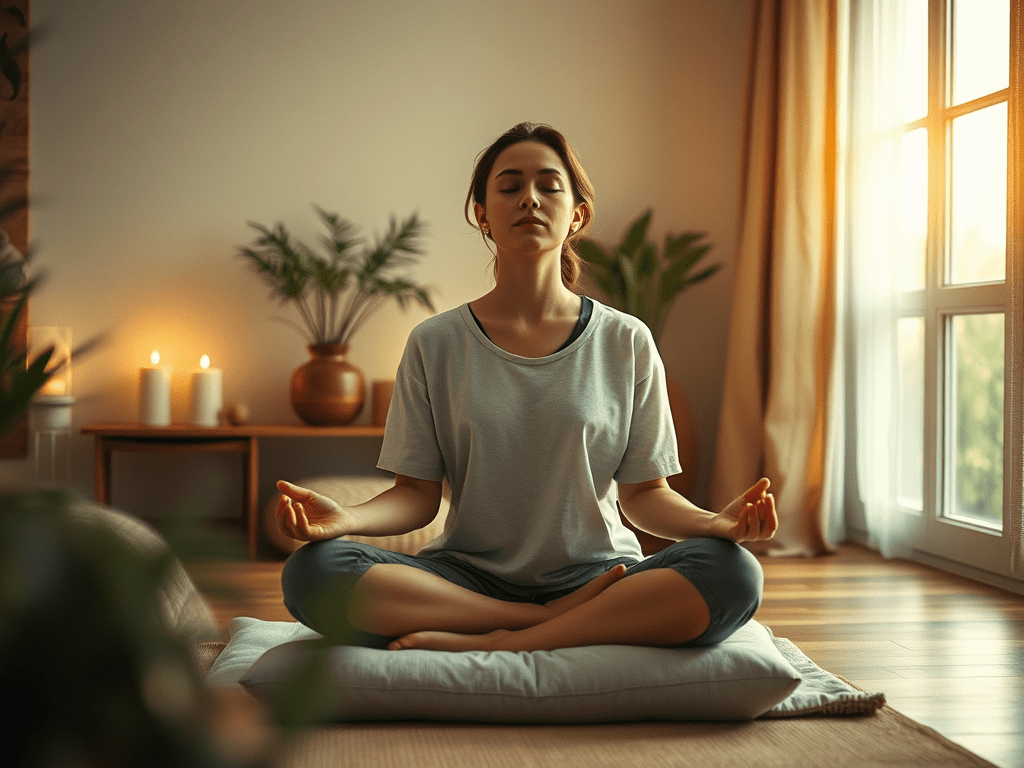
Welcome back to another installment of Meditation Monday! Today, I want to get a little personal and share my meditation journey. Spoiler alert: it hasn’t been smooth, nor have I found a perfect “zen” state. My relationship with meditation is one of ongoing exploration, much like a dance that I sometimes lead and sometimes fumble through. I’m not a guru or an expert, but I believe my story may resonate with those of you who have struggled to find the right way to meditate or fit it consistently into your life. So let’s dive in.
My Introduction to Meditation
My first introduction to meditation came during a particularly difficult period in my early twenties. I was dealing with severe anxiety and depression, feeling overwhelmed by life. I wanted solutions, and I wanted them fast. I saw a therapist who suggested I try meditation. Back then, I wasn’t really open to the idea. Meditation sounded too vague and passive for someone in the middle of an anxiety spiral like me. I was skeptical, resistant, and frankly, a little annoyed that I was being told to “just breathe” when I wanted something more concrete, like a magic pill.
At that time, I didn’t pursue it. I moved through life trying to manage my stress through traditional means—exercise, work, relationships—but the anxiety never truly left. Years passed, and the suggestion of meditation kept cropping up with different therapists. It felt like the universe was nudging me toward this practice, but I still wasn’t ready. I wasn’t in a place where I could sit with my thoughts, let alone observe them. Meditation? That was for people with calm minds, not for someone like me, who was consumed by mental chatter and racing thoughts.
Breathwork: The First Step
Fast forward a few years, and I began to explore breathwork as a small entry point into meditation. Breathing techniques, especially ones rooted in science, felt more accessible to me. I liked knowing that there was a physiological basis for breathwork—that focusing on my breath could actually reduce stress by lowering cortisol levels and regulating my nervous system. So, I started small: just a few deep breaths during moments of high anxiety, using simple techniques like box breathing (inhale for four counts, hold for four, exhale for four, hold for four). It wasn’t meditation in the traditional sense, but it was a start. It gave me a tool I could rely on when things felt overwhelming, and slowly, it opened the door to something more.
My First Guided Meditation Experience
I’ll never forget my first guided meditation experience. I was in a group therapy session, and we were asked to try progressive muscle relaxation along with a guided meditation. I went in with my usual skepticism but decided to keep an open mind. Much to my surprise, I found myself fully immersed. We started by tensing and relaxing different muscle groups, focusing on the sensations in our bodies, and then transitioned to a guided meditation. The experience was unexpectedly calming. In fact, I actually fell asleep during the session, which, for someone who deals with chronic insomnia, was an eye-opening experience. This was the first time I truly considered that meditation could do more than just help me “breathe better.” It could actually help me rest, which had been elusive for so long.
The Role of Mindfulness and DBT
As I entered my late twenties, I started seeing a new therapist who specialized in Dialectical Behavioral Therapy (DBT). DBT strongly emphasizes mindfulness, which is essentially about being present in the moment and observing your thoughts without judgment. The idea was so foreign to me at first—how could I just watch my thoughts go by without getting tangled up in them? But over time, through practice, I began to understand the value of mindfulness.
Learning to stay in the present moment, rather than ruminating on the past or worrying about the future, helped me manage my anxiety in ways I hadn’t anticipated. It wasn’t about silencing my thoughts but about giving them space to exist without letting them take over. DBT made meditation feel more grounded for me. I wasn’t trying to “empty my mind” (a concept that always felt impossible); I was learning to observe my mind, and that was a profound shift.
Discovering Visualization Meditations
As I became more comfortable with mindfulness, I decided to explore different types of meditations. Guided visualizations were a natural next step. I enjoyed being led through imaginary landscapes or scenarios, as they allowed me to detach from my day-to-day worries. At first, these felt more like escapism than meditation. But as I engaged more with these visualizations, I found they often held deeper messages for me. It wasn’t until I discovered higher self meditations—where you visualize and connect with a wiser, more enlightened version of yourself—that I began to unlock personal insights that helped me see my own life in a new light.
Through these higher self meditations, I found a way to access inner wisdom that I had long ignored. These meditations helped me process emotions, confront truths I had been avoiding, and ultimately accept where I was in my life. They weren’t always easy, and some sessions left me feeling more emotionally drained than refreshed, but they were essential in helping me deepen my practice.
Radical Acceptance: Meditation as a Tool for Life
One of the biggest takeaways from my meditation journey has been the concept of radical acceptance. This is the idea of fully accepting things as they are in the present moment, without resistance. For someone who had spent much of their life trying to control outcomes and resist unpleasant emotions, this was a game-changer. Meditation taught me to sit with discomfort, to observe it without trying to fix it immediately, and to understand that sometimes, just being with an experience is enough.
Struggling with Consistency
Now, I wish I could say that after discovering these breakthroughs, I immediately started meditating daily and never looked back. But the truth is, consistency has always been a struggle for me. Life gets busy, distractions pop up, and there are many days when meditation feels like an afterthought. However, I’ve learned not to beat myself up over it. Some weeks, I meditate daily, and others, I might only get in a session or two. And that’s okay. The beauty of meditation is that it’s always there when I’m ready to return, without judgment.
Breakthroughs Through Persistence
One of the most profound moments in my meditation journey came after about two weeks of practicing gratitude meditations. For days, it felt like nothing was happening—I would sit in silence, follow the protocol for this specific gratitude practice, and feel little change. But then, one day, something clicked. I realized certain truths about the world – truths about how people express sincere gratitude, and I felt enlightened, as if I had finally caught something that had eluded me for so long. It was as though all the small efforts had accumulated into one transformative experience. This taught me that meditation isn’t always about immediate results but about persistence, showing up even when it feels mundane, and trusting that the benefits will reveal themselves in time.
Moving Forward: My Journey Continues
So where am I now? Meditation is still a work in progress for me. I don’t always do it perfectly, and I’ve come to terms with that. It’s more about showing up and being open to the process than striving for perfection. I continue to experiment with different forms of meditation—some days, it’s breathwork; other days, it’s a visualization or a simple mindfulness practice. The most important lesson I’ve learned is that meditation doesn’t have to be perfect, but it has to be yours.
If you’re just starting out or struggling to keep up a daily practice, I hope my story encourages you. Meditation is a personal journey, one that will ebb and flow with the seasons of your life. Embrace the process, give yourself grace, and remember that even the smallest step forward is still progress.
Until next week, may your meditation journey be full of curiosity and kindness.
Wishing you all a contemplative Monday,
B.R. Quinn


 B.R. Quinn